

A continuous learning mindset is essential for any software developer who wishes to remain relevant and increase their market value. I has compiled a list of the 20 most popular books on software engineering to assist you.
This list is essential for developers who want to stay current on trends and broaden their horizons.
#1 Fluent Python by Luciano Ramalho
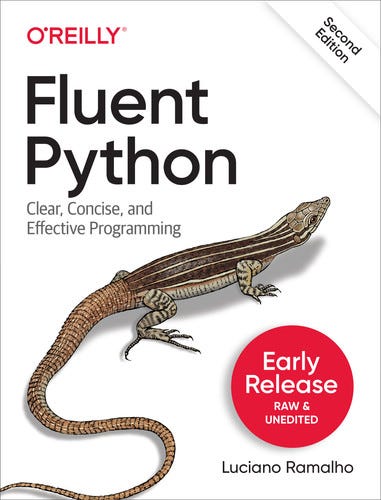
Description: Python's simplicity allows you to become productive quickly, but this often means you aren't taking advantage of everything it has to offer. This updated edition of this hands-on guide will teach you how to write effective, modern Python 3 code by leveraging the language's best ideas.
Spend no time bending Python to fit patterns learned in other languages. Discover and apply idiomatic Python 3 features that go beyond your previous knowledge. Author Luciano Ramalho walks you through Python's core language features and libraries, teaching you how to write code that is shorter, faster, and more readable.
Featuring major updates throughout the book, Fluent Python, second edition, covers:
- Special methods: The key to the consistent behavior of Python objects
- Data structures: Sequences, dicts, sets, Unicode, and data classes
- Functions as objects: First-class functions, related design patterns, and type hints in function declarations
- Object-oriented idioms: Composition, inheritance, mixins, interfaces, operator overloading, static typing, and protocols
- Control flow: Context managers, generators, coroutines, async/await, and thread/process pools
- Metaprogramming: Properties, attribute descriptors, class decorators, and new class metaprogramming hooks that are simpler than metaclasses.
#2 Learning Go by Jon Bodner

Description: Go is quickly becoming the language of choice for developing web services. While there are many tutorials available to teach Go syntax to developers with experience in other programming languages, they are insufficient. Because they do not teach Go's idioms, developers end up recreating patterns that make no sense in a Go context.
This practical guide gives you the foundation you need to write clear and idiomatic Go. You'll learn how to think like a Go developer, regardless of your level of experience. Author Jon Bodner introduces and investigates the design patterns that experienced Go developers have adopted. In addition, you'll get a sneak peek at Go's upcoming generics support and how it fits into the language.
- Learn how to write idiomatic code in Go and design a Go project
- Understand the reasons for the design decisions in Go
- Set up a Go development environment for a solo developer or team
- Learn how and when to use reflection, unsafe, and to
- Discover how to Go’s features allow the language to run efficiently
- Know which Go features you should use sparingly or not at all
#3 Fundamentals of Software Architecture by Mark Richards, Neal Ford

Description: Salary surveys around the world consistently place software architects in the top ten best jobs, but there is no real guide to help developers become architects. Until now, that is. This book is the first to provide a comprehensive overview of the many aspects of software architecture. Architectural characteristics, architectural patterns, component determination, diagramming and presenting architecture, evolutionary architecture, and many other topics will be covered by both aspiring and experienced architects.
Hands-on practitioners Mark Richards and Neal Ford, who have taught software architecture classes professionally for years, focus on architecture principles that apply across all technology stacks. You will investigate software architecture in a contemporary context, taking into account all of the innovations of the last decade.
This book examines:
- Architecture patterns: The technical basis for many architectural decisions
- Components: Identification, coupling, cohesion, partitioning, and granularity
- Soft skills: Effective team management, meetings, negotiation, presentations, and more
- Modernity: Engineering practices and operational approaches that have changed radically in the past few years
- Architecture as an engineering discipline: Repeatable results, metrics, and concrete valuations that add rigor to software architecture
#4 Python Crash Course by Eric Matthes

Description: This is the second edition of the world's best-selling Python book. Python Crash Course, 2nd Edition is a simple introduction to the fundamentals of Python programming. Author Eric Matthes avoids the sort of tedious, unnecessary information that can stymie learning how to program, instead focusing on general programming concepts, Python fundamentals, and problem-solving. Three real-world projects in the book's second section allow readers to put their knowledge to use.
Readers will learn how to create a simple video game, use data visualization techniques to make graphs and charts, and build and deploy an interactive web application. Python Crash Course, 2nd Edition teaches beginners the essentials of Python quickly so that they can build practical programs and develop powerful programming techniques.
#5 Head First Design Patterns by Eric Freeman, Elisabeth Robson

Description:
What will you learn from this book?
You know you don’t want to reinvent the wheel, so you look to Design Patterns: the lessons learned by those who’ve faced the same software design problems. With Design Patterns, you get to take advantage of the best practices and experiences of others so you can spend your time on something more challenging. Something more fun. This book shows you the patterns that matter, when to use them and why, how to apply them to your own designs, and the object-oriented design principles on which they’re based. Join hundreds of thousands of developers who’ve improved their object-oriented design skills through Head First Design Patterns.
What’s so special about this book?
If you’ve read a Head First book, you know what to expect: a visually rich format designed for the way your brain works. With Head First Design Patterns, 2E you’ll learn design principles and patterns in a way that won’t put you to sleep, so you can get out there to solve software design problems and speak the language of patterns with others on your team.
#6 Clean Code: A Handbook of Agile Software Craftsmanship by Robert C. Martin

Description: Even bad code can function. But if code isn’t clean, it can bring a development organization to its knees. Every year, countless hours and significant resources are lost because of poorly written code. But it doesn’t have to be that way.
What kind of work will you be doing? You’ll be reading code — lots of code. And you will be challenged to think about what’s right about that code, and what’s wrong with it. More importantly, you will be challenged to reassess your professional values and your commitment to your craft.
Readers will come away from this book understanding
- How to tell the difference between good and bad code
- How to write good code and how to transform bad code into good code
- How to create good names, good functions, good objects, and good classes
- How to format code for maximum readability
- How to implement complete error handling without obscuring code logic
- How to unit test and practice test-drove development
This book is a must for any developer, software engineer, project manager, team lead, or systems analyst with an interest in producing better code.
#7 Programming Rust by Jim Blandy, Jason Orendorff, Leonora F.S. Tindall

Description: The foundation for the world's computation is provided by systems programming. Writing performance-critical code necessitates the use of a programming language that allows programmers to control the use of memory, processor time, and other system resources. Rust, a systems programming language, combines that control with a modern type system that detects a wide range of common errors, from memory management errors to data races between threads.
This practical guide will teach experienced system programmers how to successfully bridge the performance-safety gap with Rust. Jim Blandy, Jason Orendorff, and Leonora Tindall show how Rust's features give programmers control over memory consumption and processor usage by combining predictable performance, memory safety, and trustworthy concurrency.You’ll learn:
- Rust’s fundamental data types and the core concepts of ownership and borrowing
- How to write flexible, efficient code with traits and generics
- How to write fast, multithreaded code without data races
- Rust’s key power tools: closures, iterators, and asynchronous programming
- Collections, strings and text, input and output, macros, unsafe code, and foreign function interfaces
#8 OCP Oracle Certified Professional Java SE 11 Developer Complete Study Guide by Jeanne Boyarsky, Scott Selikoff

Description: This is the most comprehensive prep guide available for the OCP Oracle Certified Professional Java SE 11 Developer certification — it covers Exam 1Z0–819 and the Upgrade Exam 1Z0–817 (as well as the retired Programmer I Exam 1Z0–815 and Programmer II Exam 1Z0–816)!
Java is widely-used for backend cloud applications, Software as a Service application (SAAS), and is the principal language used to develop Android applications. This object-oriented programming language is designed to run on all platforms that support Java without the need for recompilation. Oracle Java Programmer certification is highly valued by employers throughout the technology industry.
This popular guide:
- Helps you master the changes in-depth, difficultly, and new module topics of the latest OCP exams
- Covers all exam objectives such as Java arrays, primitive data types, string APIs, objects and classes, operators and decision constructs, and applying encapsulation
- Allows developers to catch up on all of the newest Java material like lambda expressions, streams, concurrency, annotations, generics, and modules
- Provides practical methods for building Java applications, handling exceptions, programming through interfaces, secure coding in Java SE, and more
- Enables you to gain the information, understanding, and practice you need to pass the OCP exams
#9 Software Architecture: The Hard Parts by Neal Ford, Mark Richards, Pramod Sadalage, Zhamak Dehghani

Description: There are no easy decisions in software architecture. Instead, there are many hard parts — difficult problems or issues with no best practices — that force you to choose among various compromises. With this book, you’ll learn how to think critically about the trade-offs involved with distributed architectures.
Architecture veterans and practicing consultants Neal Ford, Mark Richards, Pramod Sadalage, and Zhamak Dehghani discuss strategies for choosing an appropriate architecture. By interweaving a story about a fictional group of technology professionals — the Sysops Squad — they examine everything from how to determine service granularity, manage workflows and orchestration, manage and decouple contracts, and manage distributed transactions to how to optimize operational characteristics, such as scalability, elasticity, and performance.
By focusing on commonly asked questions, this book provides techniques to help you discover and weigh the trade-offs as you confront the issues you face as an architect.
- Analyze trade-offs and effectively document your decisions
- Make better decisions regarding service granularity
- Understand the complexities of breaking apart monolithic applications
- Manage and decouple contracts between services
- Handle data in a highly distributed architecture
- Learn patterns to manage workflow and transactions when breaking apart applications
#10 Software Engineering at Google by Titus Winters, Tom Manshreck, Hyrum Wright

Description: Today's software engineers must understand not only how to program effectively, but also how to develop proper engineering practices in order to keep their codebase healthy and sustainable. The distinction between programming and software engineering is emphasized in this book.
How do software engineers manage a living codebase that evolves and responds to changing requirements and demands over time? Titus Winters and Hyrum Wright of Google, along with technical writer Tom Manshreck, present a candid and insightful look at how some of the world's leading practitioners construct and maintain software. This book examines Google's distinct engineering culture, processes, and tools, as well as how these elements contribute to an engineering organization's effectiveness.
You’ll explore three fundamental principles that software organizations should keep in mind when designing, architecting, writing, and maintaining code:
- How time affects the sustainability of software and how to make your code resilient over time
- How scale affects the viability of software practices within an engineering organization
- What trade-offs a typical engineer needs to make when evaluating design and development decisions
#11 Python for Data Analysis by Wes McKinney

Description: Get complete instructions for manipulating, processing, cleaning, and crunching datasets in Python. Updated for Python 3.6, the second edition of this hands-on guide is packed with practical case studies that show you how to solve a broad set of data analysis problems effectively. You’ll learn the latest versions of pandas, NumPy, IPython, and Jupyter in the process.
Written by Wes McKinney, the creator of the Python pandas project, this book is a practical, modern introduction to data science tools in Python. It’s ideal for analysts new to Python and for Python programmers new to data science and scientific computing. Data files and related material are available on GitHub.
- Use the IPython shell and Jupyter notebook for exploratory computing
- Learn basic and advanced features in NumPy (Numerical Python)
- Get started with data analysis tools in the panda’s library
- Use flexible tools to load, clean, transform, merge, and reshape data
- Create informative visualizations with matplotlib
- Apply the pandas groupby facility to slice, dice, and summarize datasets
- Analyze and manipulate regular and irregular time series data
- Learn how to solve real-world data analysis problems with thorough, detailed examples
#12 Effective Java by Joshua Bloch

Description: Java has changed dramatically since the previous edition of Effective Java was published shortly after the release of Java 6. This Jolt award-winning classic has now been thoroughly updated to take full advantage of the latest language and library features. The support in modern Java for multiple paradigms increases the need for specific best-practices advice, and this book delivers.
As in previous editions, each chapter of Effective Java, Third Edition, consists of several "items," each presented in the form of a short, stand-alone essay that provides specific advice, insight into Java platform subtleties, and updated code examples. The comprehensive descriptions and explanations for each item illuminate what to do, what not to do, and why.
The book covers:
- Functional interfaces, lambda expressions, method references, and streams
- Default and static methods in interfaces
- Type inference, including the diamond operator for generic types
- The @SafeVarargs annotation
- The try-with-resources statement
- New library features such as the Optional interface, java. time, and the convenience factory methods for collections
#13 Introducing Python by Bill Lubanovic

Description: Easy to understand and fun to read, this updated edition of Introducing Python is ideal for beginning programmers as well as those new to the language. Author Bill Lubanovic takes you from the basics to more involved and varied topics, mixing tutorials with cookbook-style code recipes to explain concepts in Python 3. End-of-chapter exercises help you practice what you’ve learned.
You’ll gain a strong foundation in the language, including best practices for testing, debugging, code reuse, and other development tips. This book also shows you how to use Python for applications in business, science, and the arts, using various Python tools and open source packages.
#14 40 Algorithms Every Programmer Should Know by Imran Ahmad

Description: Algorithms have always played an important role in both the science and practice of computing. Beyond traditional computing, the ability to use algorithms to solve real-world problems is an important skill that any developer or programmer must-have. This book will help you not only to develop the skills to select and use an algorithm to solve real-world problems but also to understand how it works.
What you will learn:
- Explore existing data structures and algorithms found in Python libraries
- Implement graph algorithms for fraud detection using network analysis
- Work with machine learning algorithms to cluster similar tweets and process Twitter data in real-time
- Predict the weather using supervised learning algorithms
- Use neural networks for object detection
- Create a recommendation engine that suggests relevant movies to subscribers
- Implement foolproof security using symmetric and asymmetric encryption on the Google Cloud Platform (GCP)
Who this book is for:
This book is for programmers or developers who want to understand the use of algorithms for problem-solving and writing efficient code. Whether you are a beginner looking to learn the most commonly used algorithms in a clear and concise way or an experienced programmer looking to explore cutting-edge algorithms in data science, machine learning, and cryptography, you’ll find this book useful. Although Python programming experience is a must, knowledge of data science will be helpful but not necessary.
#15 The Pragmatic Programmer: your journey to mastery by David Thomas, Andrew Hunt

Description: The Pragmatic Programmer is one of those rare technical books that you'll read, re-read, and re-read over and over again. Whether you're new to the field or an experienced practitioner, you'll always leave with new insights.
Personal responsibility and career development are discussed, as well as architectural techniques for keeping your code flexible and easy to adapt and reuse. If you read this book, you will learn how to:
- Fight software rot
- Learn continuously
- Avoid the trap of duplicating knowledge
- Write flexible, dynamic, and adaptable code
- Harness the power of basic tools
- Avoid programming by coincidence
- Learn real requirements
- Solve the underlying problems of concurrent code
- Guard against security vulnerabilities
- Build teams of Pragmatic Programmers
- Take responsibility for your work and career
- Test ruthlessly and effectively, including property-based testing
- Implement the Pragmatic Starter Kit
- Delight your users
#16 Clean Architecture: A Craftsman’s Guide to Software Structure and Design by Robert C. Martin

Description: This book is packed with direct, no-nonsense solutions for the real challenges you’ll face–the ones that will make or break your projects.
- Learn what software architects need to achieve–and core disciplines and practices for achieving it
- Master essential software design principles for addressing function, component separation, and data management
- See how programming paradigms impose discipline by restricting what developers can do
- Understand what’s critically important and what’s merely a "detail"
- Implement optimal, high-level structures for web, database, thick-client, console, and embedded applications
- Define appropriate boundaries and layers, and organize components and services
- See why designs and architectures go wrong, and how to prevent (or fix) these failures
Clean Architecture is essential reading for every current or aspiring software architect, systems analyst, system designer, and software manager–and for every programmer who must execute someone else’s designs.
#17 Learning Domain-Driven Design by Vlad Khononov

Description: Building software is more difficult than ever. As a developer, you must not only keep up with ever-changing technological trends, but you must also understand the business domains that underpin the software. This practical book will teach you how to analyze business domains, understand business strategy, and, most importantly, align software design with business needs.
Author Vlad Khononov demonstrates how these practices lead to robust business logic implementation and help to future-proof software design and architecture. You'll investigate the relationship between domain-driven design (DDD) and other methodologies in order to make architectural decisions that meet business needs. You'll also learn about the real-world experience of implementing DDD in a startup company.
With this book, you’ll learn how to:
- Analyze a company’s business domain to learn how the system you’re building fits its competitive strategy
- Use DDD’s strategic and tactical tools to architect effective software solutions that address business needs
- Build a shared understanding of the business domains you encounter
- Decompose a system into bounded contexts
- Coordinate the work of multiple teams
- Gradually introduce DDD to brownfield projects
#18 Grokking Algorithms by Aditya Bhargava, Jed Limke

Description: Grokking Algorithms is a friendly take on this core computer science topic. In it, you’ll learn how to apply common algorithms to the practical programming problems you face every day. You’ll start with tasks like sorting and searching. As you build up your skills, you’ll tackle more complex problems like data compression and artificial intelligence. Each carefully presented example includes helpful diagrams and fully annotated code samples in Python. By the end of this book, you will have mastered widely applicable algorithms as well as how and when to use them.
#19 C# 9.0 in a Nutshell by Joseph Albahari

Description: When you have questions about C# 9.0 or .NET 5, this best-selling guide has the answers you need. C# is a language of unusual flexibility and breadth, but with its continual growth, there’s so much more to learn. In the tradition of O’Reilly’s Nutshell guides, this thoroughly updated edition is simply the best one-volume reference to the C# language available today.
Organized around concepts and use cases, C# 9.0, in a Nutshell, provides intermediate and advanced programmers with a concise map of C# and .NET that also plumbs significant depths.
- Get up to speed on C#, from syntax and variables to advanced topics such as pointers, records, closures, and patterns
- Dig deep into LINQ with three chapters dedicated to the topic
- Explore concurrency and asynchrony, advanced threading, and parallel programming
- Work with .NET features, including regular expressions, networking, spans, reflection, and cryptography
#20 Microservices Patterns by Chris Richardson

Description: Microservices Patterns shows you how to create and deploy high-quality microservices-based applications. This invaluable set of design patterns adds new patterns for writing services and composing them into systems that scale and perform reliably under real-world conditions, building on decades of distributed system experience. This practical guide provides experience-driven advice to help you design, implement, test, and deploy your microservices-based application.

Very informative and impressive post you have written,
ReplyDeletethis is quite interesting and I have gone through it completely, an upgraded information is shared, and keep sharing such valuable information.
Health Derive