

The success of a blockchain project is inextricably linked to the rise in the value of its token. The higher the token price, the greater the popularity of the blockchain project. Supply, demand, and tokenomics are all factors that influence the token price.
Tokenomics is all about the mechanics of how an asset works, as well as the psychological or behavioral forces that can affect its value in the long run.
This can be a motivation factor for investors to invest in the project as well as the project development team.
A project with good tokenomics has the potential for long-term growth because it creates an incentive to buy and hold tokens.
So, what factors should be considered when designing tokenomics?
Token supply and distribution
The development team and investment funds that contribute to the project in its early stages are the groups that can hold a large number of tokens at a base price. This means that this group will have a lot of selling power.
If the distribution of tokens in this group is not regulated, it will have a negative impact on the token price balance and, of course, will make token distribution unfair. Of course, that is not the point of a decentralized blockchain.
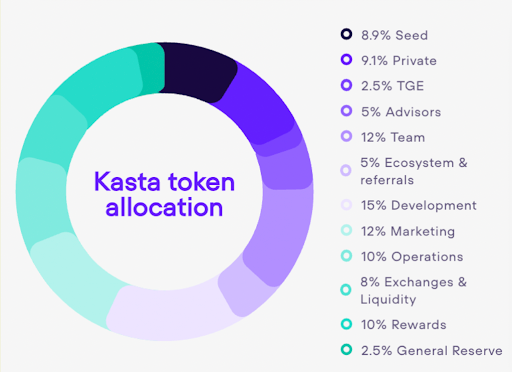
From the token ratio in the picture, it can be seen that the highest allocation is only 15%. It looks reasonable, doesn't it? But it's not that simple. Let's dissect them one by one.
- Investors: Seed and Private – 18%
- Development team, including: Executive Team, Advisory, Ecosystem Introduction, Product Development, Marketing, Operations, Awards, and General Reserve – 71.5%
- Market Makers: Trading and Liquidity – 8%
- Retail investors: raise capital, raise funds. 2.5%
This means that 97.5% of tokens are in the hands of investment funds and development teams. With a base fee of $0.02/token, they will have full control of the token economy.
The project needs to carefully calculate the number of tokens allocated to the development team in order to create product development momentum, but at the same time limit its possible influence on the market.
In addition, it is necessary to implement a token locking mechanism for the development team and establish a phased schedule for token unlocking.
This is useful for maintaining the commitment of the team so that they do not immediately sell all the assets obtained, which as a result can make the token price fall quickly. Generally, the application period is 1-2 years.
Token utility
A good token is one that has applications. This will be an important consideration for potential buyers when making a purchase decision.
Token deployments can differ greatly. Aside from general and simple features like administration and profit farming, the nature of the project will dictate more specific features.
In contrast to token supply and distribution, free projects are innovative in creating efficient token applications.
For example, in GameFi, if it is a token that pays gamers, it will cause inflation, and it will be difficult to increase the price of the token.
In the case of using the main token to buy important in-game items such as buying Metamon on RadioCaca, if the token price is too high, new players will not be able to afford to play. Therefore, the GameFi project needs to separate the interests of investors and gamers.
Token Model Adoption
Projects need to choose whether their token will adopt a deflationary, inflationary or hybrid model.
Deflationary
Most investors prefer this model because the token supply is fixed. Avax, BNB, and Luna were among the projects that carried out deflation.
Through the coin or token burning mechanism, the supply of these tokens will only decrease over time.
The deflation model has the advantage of being simple to design and requiring few mathematical formulas to construct an effective deflation model, which is why many projects favor it.
Inflation
In the inflation model, tokens will not have a fixed supply and will be minted more over time. That means the supply will increase gradually.
Tokens can be added on a fixed schedule, printed according to a nonlinear equation, or printed on demand.
Inflation models are much more difficult to design and maintain than deflation models.
However, there are some rules in designing the inflation token model that need special attention, namely:
Printing more tokens on demand is not allowed. This is feared by investors because it will lead to uncontrolled inflation.
Inflation greater than 200%/yr will make it very difficult to sustain the token economy model.
The best option is to keep inflation below 150%/yr. However, inflation is not always a bad thing. For example, in a normal economy, the currency must always have a certain rate of inflation to help boost the economy.
Several major ecosystems currently use inflation models, such as Ethereum and Polkadot.
In addition to deflation and inflation, the token economy has a hybrid model. The Solana blockchain project has already implemented this.
Many projects, including Solana, have successfully integrated hybrid models into their tokenomics.
The SOL token is an inflation token on the blockchain, but due to its initial inflation rate of 8%, it will gradually decrease over the next 10 years until it reaches 1.5% per annum.
Then, for each transaction with calculations, the deflation method is in the token burning mechanism. With a large volume of on-chain transactions, the annual burn rate will be greater than 1.5%.
Based on this explanation, each model has its own advantages and disadvantages depending on the project objectives.
It is important to carefully consider the use of the supply model and provide an accurate calculation.
Those are the important points in the token economy that you need to know. The process of designing tokenomics is not an easy matter, so consulting with experts can be an option so that token distribution can run well and benefit all parties.
"Designing tokenomics will be the first difficult problem that startups will have to face. Therefore, the project should first consult some successful projects or seek experienced advisors in the market to avoid unnecessary things," said Nhat Phan, CEO and Co-Founder of BHO Network.
BHO also launched the Launchpad BHO product, which acts as an incubator to support the development of potential projects, to assist startups of new blockchain projects.
These projects can seek assistance from the BHO Network and BHO Launchpad in developing an efficient, secure, and long-term tokenomic model.

Post a Comment
Post a Comment